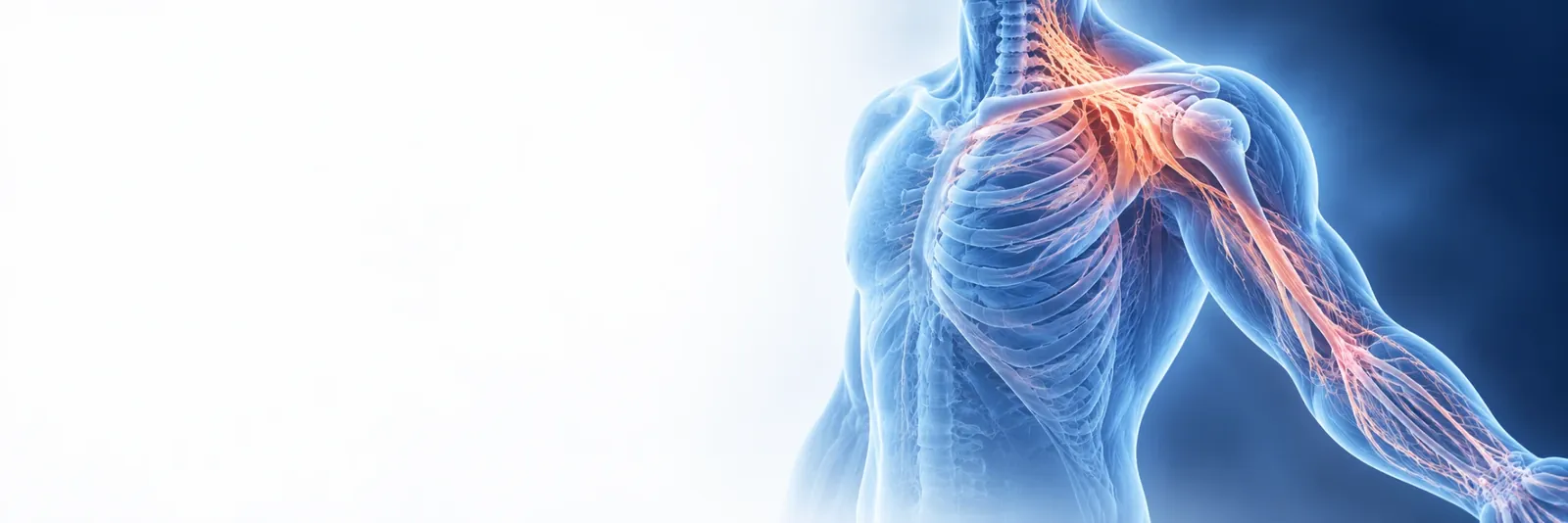
The brachial plexus is the network of nerves that runs from the neck to the shoulder and arm. It can be stretched, torn or pulled off the spinal cord in road accidents, falls and difficult births. When the nerves do not recover on their own, surgery to repair, graft or transfer nerves, sometimes with muscle or tendon transfers, may restore useful movement.
Who it may help
- No improvement in arm function in the first 3 to 6 months after the injury
- A baby with persistent weakness of the shoulder or arm after birth (Erb’s palsy)
- Scans showing a nerve-root avulsion or severe injury
- Nerve studies (EMG/NCS) that show no sign of recovery
- Wasting of muscles, stiff joints or pain that is getting worse
- Having been told that nothing more can be done
Conditions treated
- Traumatic injuries of the upper or lower plexus, for example after a motorbike accident
- Root avulsions and nerve ruptures
- Erb’s palsy and other birth-related injuries
- Late or neglected cases
- Failed earlier repairs
- Combined nerve, muscle and joint damage
Techniques used
- Nerve transfer A healthy, less important nerve nearby is connected to the paralysed muscle’s nerve so that it can power the muscle.
- Nerve grafting A nerve taken from the leg (such as the sural nerve) bridges a gap in the injured nerve.
- Neurolysis or direct repair Freeing or repairing a partly damaged nerve.
- Free functional muscle transfer A muscle (for example the gracilis from the thigh) is moved to the arm and given a new nerve supply.
- Tendon transfers For late cases, to improve movement.
Before the procedure
- High-resolution MRI or CT myelogram of the plexus
- Nerve and muscle tests (EMG/NCS)
- Physiotherapy assessment of the joints
- A planning session to choose donor nerves and muscles
- Honest counselling on what is realistic, how long recovery takes and what rehabilitation involves
Recovery: what to expect
- A hospital stay of about 5 to 7 days.
- A sling or splint for 2 to 3 weeks to protect the repair.
- Guided physiotherapy begins at 2 to 4 weeks.
- First signs of nerve recovery usually appear after 3 to 6 months; the full benefit can take 12 to 18 months.
- Clinic and EMG review about every three months.
These are typical timings. Your own plan depends on your condition, your general health and the operation chosen, and Dr. Chakraborty will go through it with you.
Risks to know about
Every operation carries risk. The ones most relevant here are:
- Incomplete recovery, or recovery that is slower than hoped
- Numbness or weakness at the site of a donor nerve
- Infection, bleeding or scarring
- Joint stiffness if physiotherapy is not kept up
- The need for further reconstructive surgery
Your own risks depend on your health and your scans, and are explained in detail before you decide on anything.
Common questions
When should surgery be done?
Ideally within 3 to 6 months of the injury. Earlier repair gives the nerve more time to regenerate.
Will the arm recover completely?
Recovery depends on the type of injury, timing, and rehabilitation. Many people regain useful shoulder and elbow movement, but a full recovery is not always possible.
Is there an age limit?
No. Children, adults and older people can all benefit if the case is suitable.
Will taking a donor nerve cause weakness?
Donor nerves are chosen so that the loss elsewhere is small and not noticeable in daily life.
This page is general information to help you prepare for a consultation. It is not medical advice and does not replace an examination. Every plan is made for the individual patient.